
The Mechanics of Auto-Retractable Ratchet Straps: A Complete User Guide

Dustin Xu
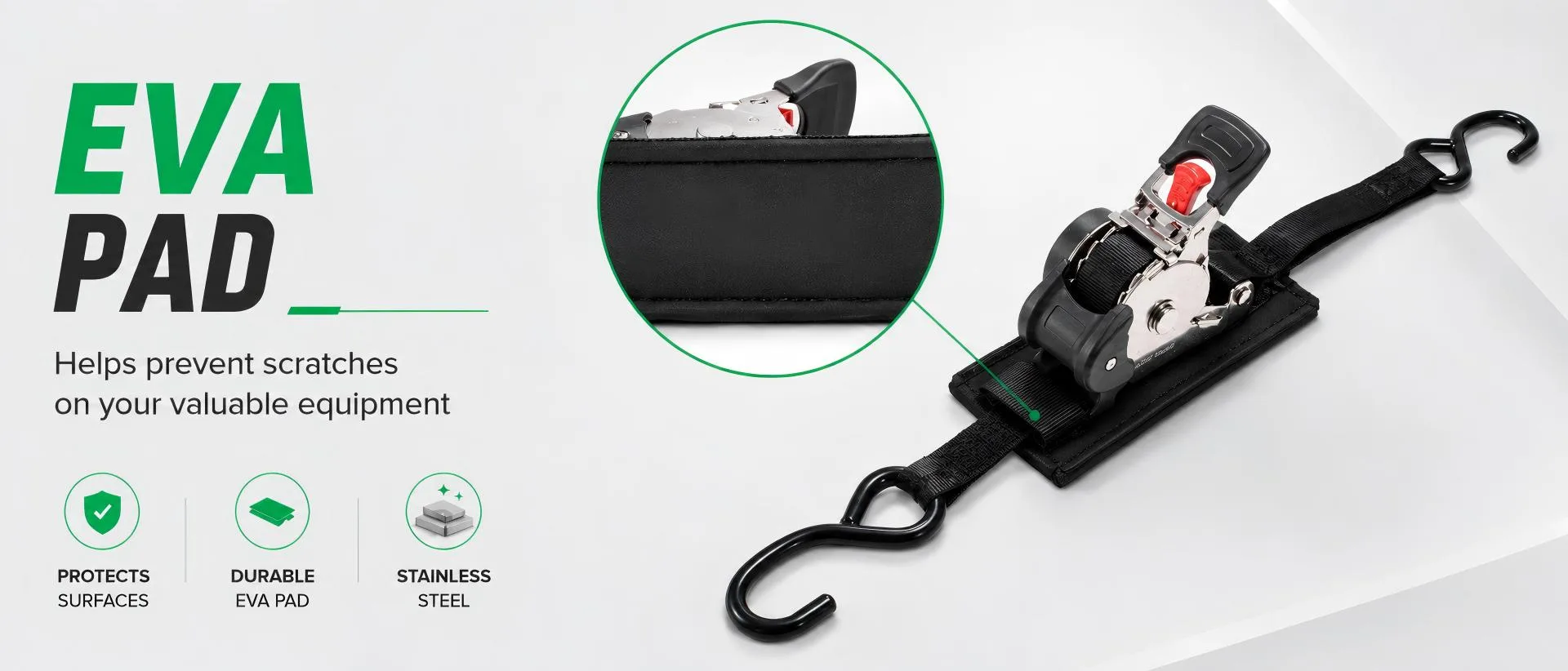
Overview: For logistics professionals, outdoor enthusiasts, and powersports owners, traditional ratchet straps often present a frustrating challenge: tangled webbing and loose ends flapping in the wind. Auto-Retractable Ratchet Straps solve these issues by utilizing an internal spring-loaded mechanism, similar to an automotive seatbelt. This guide breaks down how these advanced tie-downs operate, their practical advantages—including crucial surface protection features—and why prioritizing a high breaking strength, such as the upgraded 1763 lbs BS engineered by PioneersGears, is critical for safe cargo control.
How the Automatic Retraction Mechanism Works
The core innovation of an auto-retractable strap lies in its central housing. Instead of manually threading a loose piece of webbing through a mandrel, the webbing is permanently attached to a pre-tensioned, spring-loaded spool inside the buckle assembly.
When the user presses the release button (often a distinct color like red or yellow), the spool unlocks. You can then pull out the exact length of webbing required to reach your anchor point. Once the tension is released, the internal torsion spring automatically reels in any excess slack. This mechanism completely eliminates the need to tie off "tail ends" and ensures the strap retracts neatly into a compact unit for storage.
$$Image Placeholder: Insert a high-quality product image here showcasing the retractable housing, the release button, and the webbing partially pulled out.$$
Surface Protection: The Integrated EVA Pad
One critical design flaw of traditional heavy-duty ratchets is the exposed metal chassis. When tightened over a motorcycle, ATV, or kayak, the bare metal can easily scratch expensive paint jobs, dent chrome, or gouge carbon fiber surfaces.
To counter this, advanced auto-retractable straps are engineered with a built-in EVA (Ethylene-Vinyl Acetate) protective pad sewn directly underneath the metal ratchet housing. This thick, durable, and weather-resistant foam barrier rests between the heavy-duty hardware and your cargo. It acts as a shock absorber and a friction guard, ensuring that even under the extreme tension of a heavy load, your vehicle's surface remains entirely scratch-free.
Step-by-Step: How to Use an Auto-Retractable Strap
Operating an automatic strap is highly intuitive and significantly reduces loading and unloading times compared to traditional tie-downs:
To Secure Cargo:
- Anchor the Base: Attach the fixed-end S-hook (attached directly to the ratchet body) to your primary anchor point.
- Extend the Webbing: Press and hold the release button, then pull the webbing out to the desired length.
- Anchor the Strap: Attach the second S-hook to your opposing anchor point.
- Tighten: Release the button and pump the ratchet handle up and down to apply tension until the cargo is firmly secured. The excess webbing is already safely stored inside the housing, while the EVA pad protects the cargo underneath.
To Release Cargo:
- Unlock: Press the release button and fully open the ratchet handle past its resistance point so it lies flat.
- Loosen: Lift the webbing slightly to release the tension, then unhook both ends.
- Auto-Retract: Simply press the release button, and the strap will smoothly roll itself back into the housing.
The Safety Imperative: Understanding the 1763 lbs Upgrade
While the convenience of auto-retractable straps is undeniable, earlier generations of this technology often compromised on load capacity to fit the webbing onto the internal spool. Standard 1-inch retractable straps frequently max out at 600 to 1000 lbs Breaking Strength (BS).
To meet the demands of heavy-duty transport, PioneersGears has engineered an upgraded assembly boasting a 1763 lbs Breaking Strength (BS).
Why does this specific capacity matter? During transport, cargo experiences dynamic loads. Hitting a pothole, harsh braking, or cornering multiplies the force exerted on the strap. A 1763 lbs BS provides a substantial safety margin, ensuring that heavy items like motorcycles, ATVs, and heavy machinery remain immobilized even under sudden gravitational stress.
Key Advantages Over Traditional Tie-Downs
For commercial fleets and regular users, upgrading to retractable models offers distinct operational benefits:
- Zero Tangled Webbing: The self-storing design means no more spending 10 minutes untangling a "spaghetti mess" of straps before loading a vehicle.
- Elimination of Wind-Whip: Because there is no excess webbing left over after tightening, there are no loose ends to flap in the wind at highway speeds, preventing abrasive damage to vehicle paint and preserving the life of the strap.
- Damage-Free Transport: The combination of the soft EVA base pad and vinyl-coated S-hooks ensures comprehensive protection for your most sensitive gear.
- Enhanced Efficiency: The intuitive pull-and-ratchet operation cuts loading and unloading times by up to 50%, an essential factor for commercial logistics.
Frequently Asked Questions (Technical Inquiries)
Q1: Can the internal spring mechanism break or jam over time?
A: Premium retractable straps are built with high-carbon torsion springs housed in a protective casing to prevent dust and debris intrusion. Routine maintenance, such as ensuring the webbing is dry and clean before retracting, will ensure years of reliable operation.
Q2: Are auto-retractable straps long enough for securing large ATVs or side-by-sides?
A: Yes. While the internal housing does limit the absolute maximum length compared to standard open-spool straps, premium auto-retractable models typically offer up to 10 feet (3 meters) of webbing. This is the optimal length for securing powersports vehicles to flatbeds or trailers without maxing out the spool.
Q3: What happens if mud or water gets inside the retractable housing during off-road use?
A: The housing is designed to shield the internal spring from most debris. However, if the strap is submerged in thick mud, it's best to pull the webbing all the way out, rinse it with clean water, and let it dry before pressing the retract button. This simple maintenance prevents the internal spool from jamming and keeps the mechanism operating smoothly.
Q4: Will the EVA pad absorb water or degrade in the sun?
A: No. EVA (Ethylene-Vinyl Acetate) is a premium closed-cell foam. This means it is completely waterproof and will not absorb rain or moisture like standard open-cell sponges. It is also highly resistant to UV rays, ensuring it won't crack, crumble, or flatten out after prolonged exposure to the sun.
About PioneersGears
PioneersGears is your expert in application-driven cargo control and mobility restraints. We design and manufacture purpose-built, OEM/ODM custom tie-down solutions for industry-specific transport and securement scenarios.