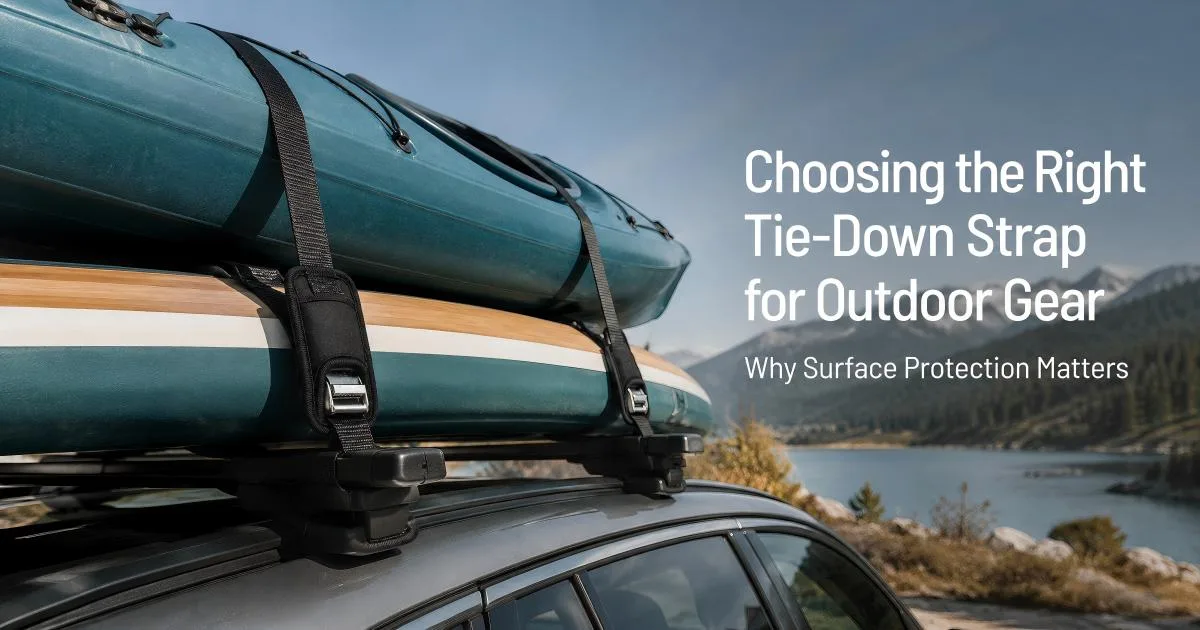
Choosing the Right Tie-Down Strap for Outdoor Gear: Why Surface Protection Matters

Dustin Xu
When people choose a tie-down strap, they often start with one question: how strong is it?
Strength matters, of course. But for outdoor equipment, it is not the only thing buyers should look at.
Kayaks, paddle boards, surfboards, roof boxes, camping gear, and roof rack accessories are different from steel cargo or industrial goods. Many of them have painted, coated, plastic, rubber, or composite surfaces. Some are curved, lightweight, or easy to mark during loading.
In these cases, a strap should do more than hold the load. It should also be easy to adjust, easy to release, and gentle enough for the equipment being secured.
That is why surface-friendly strap design is becoming more important in outdoor and watersports accessory products.
Outdoor Gear Needs a Different Type of Tie-Down Thinking
A heavy-duty ratchet strap is not always the best answer for every application.
For many recreational products, the goal is not to apply maximum tension. The goal is to hold the item firmly without over-tightening or damaging the surface.
This is especially true for:
Kayaks and canoes
Paddle boards and surfboards
Roof rack cargo
Camping storage boxes
Bike and travel accessories
Light marine and watersports equipment
For these products, users usually want something quick, compact, and simple. They may be loading gear alone, standing beside a vehicle, or working in wet outdoor conditions. The strap needs to feel practical in real use, not just strong on paper.
Why Buckle Contact Is Often Overlooked
When a strap is tightened, buyers usually focus on the webbing. But the buckle area is often the part that causes contact with the cargo.
During loading, the buckle may slide, rotate, or rest against the surface being secured. On hard cargo, this may not matter. But on a kayak, board, painted rack, or coated accessory, a bare metal buckle can become a problem.
This is not always about serious damage. Sometimes it is small scratches, rubbing marks, noise during transport, or simply a less premium user experience.
For outdoor brands, these details matter because end users notice them.
A strap that feels safe against the product surface is easier to sell as an accessory for recreational and lifestyle markets.
Cam Buckle vs. Ratchet Strap for Outdoor Equipment
Ratchet straps are useful when high tension is required. They are common in cargo control, trucking, trailers, and heavier transport applications.
Cam buckle straps serve a different purpose.
They are usually better for light-duty outdoor gear where the user wants controlled hand tension instead of heavy mechanical force.
Cam buckle straps are often a better fit when:
The cargo surface is more delicate
The load does not need high ratcheting force
Fast adjustment is more important than maximum tension
The product needs to be lightweight and easy to store
The strap is part of a retail outdoor accessory kit
This is why cam buckle straps are commonly used for kayaks, paddle boards, surfboards, roof racks, and camping equipment.
What Buyers Should Check Before Choosing an Outdoor Strap
For B2B buyers, choosing the right strap is not only about unit price. The strap has to match the application, packaging, end-user expectations, and brand positioning.
1. Is the tension method appropriate?
For boards, kayaks, and roof rack cargo, hand-tightened cam buckles are often easier to control than ratchets. They reduce the risk of over-tightening and make the product easier for casual users.
2. Will the buckle touch the cargo?
If the buckle may rest against the secured item, surface protection becomes important. A covered buckle or soft contact layer can improve the user experience.
3. Is the hardware suitable for outdoor use?
Outdoor products may be exposed to moisture, road dust, salt air, or repeated handling. Hardware selection should match the environment where the strap will be used.
4. Is the strap easy to understand at retail?
A basic strap is difficult to differentiate. A strap with a clear application story, such as roof rack use or board protection, is easier for distributors and retail buyers to position.
5. Can the strap be customized into a kit?
For OEM and private-label programs, length, color, label, packaging, and set configuration can make the same basic strap fit different product lines.
A Practical Strap Design for Surface-Friendly Use
For applications where the buckle may contact the cargo surface, a protected cam buckle design is a practical choice.
One example is a 1 inch cam buckle strap using stainless steel hardware with a sewn neoprene buckle cover. The cam buckle allows quick hand adjustment, while the soft cover helps reduce direct metal contact with the secured item.
This type of design works well for outdoor and watersports categories because it solves a real use-case problem without making the product complicated.
Typical product positioning includes:
Roof rack strap
Kayak tie-down strap
Paddle board strap
Surfboard strap
Camping gear strap
Light marine accessory strap
Private-label outdoor tie-down kit
For this type of product, a common specification can include 772 lbs / 350 kg breaking strength, 1 inch webbing, custom length options, and OEM packaging support.
Why This Matters for Outdoor Brands and Distributors
Outdoor products are often sold on usability, not only technical strength.
A better strap design can help reduce customer complaints, improve perceived quality, and make the product easier to explain in packaging and online listings.
For brands and distributors, details like a covered buckle, stainless steel hardware, custom webbing color, and clean packaging can move the product away from “generic strap” positioning and closer to a specialized outdoor accessory.
That is important in categories like kayaking, paddle boarding, camping, roof rack accessories, and marine recreation, where customers often compare products visually before reading detailed specifications.
Conclusion
The right tie-down strap for outdoor gear should match the way the product is actually used.
For kayaks, boards, roof racks, camping gear, and light marine accessories, users often need controlled tension, quick adjustment, and surface-friendly contact more than maximum ratcheting force.
A cam buckle strap with protected hardware offers a simple and practical solution. It keeps the strap easy to use while making it more suitable for delicate or finished outdoor equipment.
For OEM buyers, this type of strap is also easier to turn into a branded retail product, with custom length, color, logo, packaging, and kit options.
FAQ
Are cam buckle straps good for kayaks and paddle boards?
Yes. Cam buckle straps are commonly used for kayaks, paddle boards, surfboards, and roof rack cargo because they provide controlled hand tension and are easy to adjust.
When should I use a cam buckle strap instead of a ratchet strap?
Use a cam buckle strap when the load is light-duty and does not require high mechanical tension. Ratchet straps are better for heavier cargo or applications that need stronger tightening force.
Why does buckle protection matter?
The buckle area may touch the cargo during tightening or transport. A protective cover can help reduce direct metal contact with painted, coated, plastic, or composite surfaces.
What breaking strength is suitable for light outdoor gear?
It depends on the application and securing method. For light-duty outdoor use, straps around 772 lbs / 350 kg breaking strength can be suitable when used correctly and matched to the load.
Can outdoor straps be customized for retail programs?
Yes. Common customization options include length, webbing color, buckle material, logo label, packaging, and single-pack or multi-pack kit formats.
About PioneersGears
PioneersGears is your expert in application-driven cargo control and mobility restraints. We design and manufacture purpose-built, OEM/ODM custom tie-down solutions for industry-specific transport and securement scenarios.