
Rope Ratchet 101: Core Technology and Sizing Guide (1/8" to 1/2")

Dustin Xu
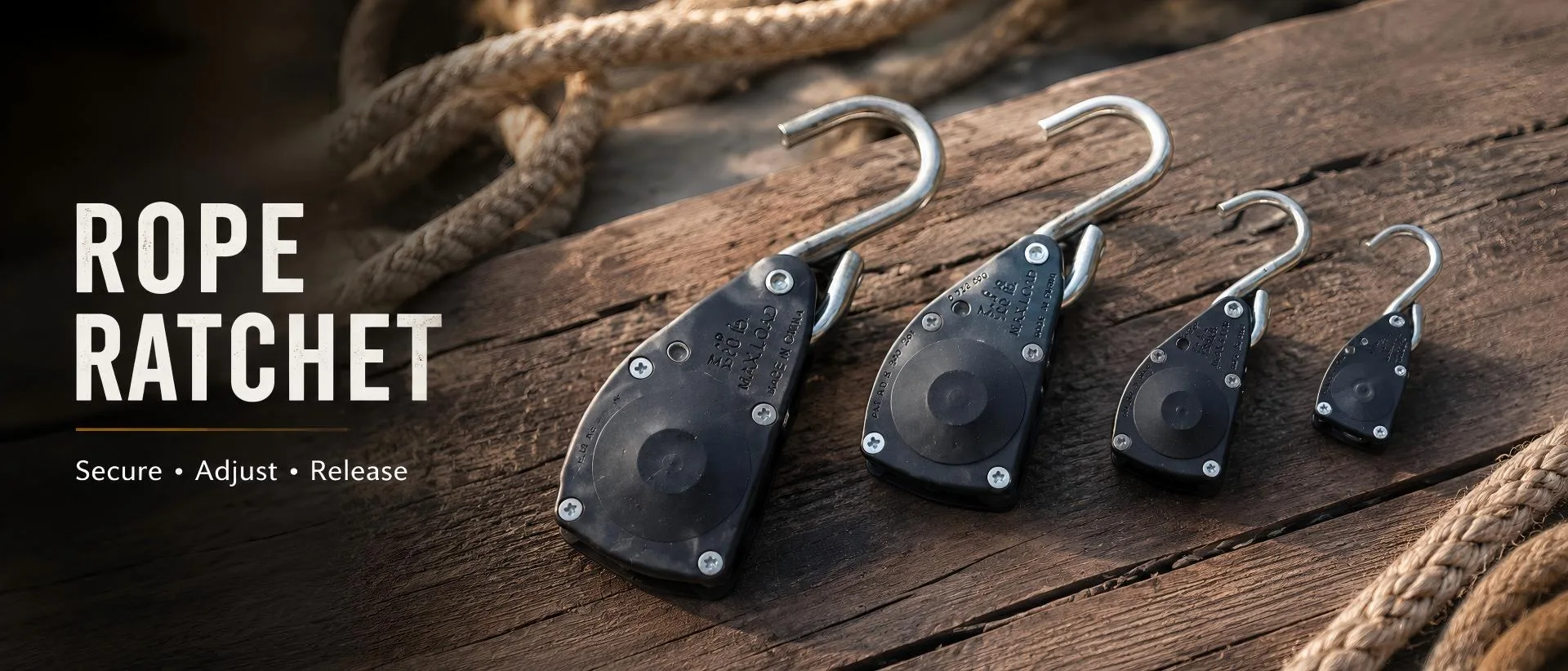
Whether you’re working in industrial logistics, indoor agriculture, overland travel, or precision load suspension, you face a deceptively simple but critical challenge: How do you tension and secure a load safely and efficiently?
Traditionally, people have relied on complex knots or webbing ratchet straps—both with clear drawbacks. Knots can slip under dynamic loads or seize when wet. Webbing ratchet straps are limited by spool capacity; as the webbing stacks on the spool, it can “bind,” forcing you to release tension and start over.
The Continuous Rope Ratchet was engineered to address these issues. In this 101 guide, we’ll break down how it works and explain the four core sizes (from 1/8" to 1/2") so you can choose the right tie-down solution.
The Core Tech: Say Goodbye to Binding
Unlike traditional systems that rely on spooling, the Rope Ratchet uses an ingenious “pull-through” dynamic architecture.
A solid braided rope passes directly through a precision-engineered, serrated sheave inside the housing. Because the rope pulls through the device rather than wrapping around an axle, there’s no arbitrary limit to the length of rope you can tension. Attach the hooks, pull the free end of the rope, and the internal metal pawl locks the gear, capturing and holding tension with minimal slippage.
The "Trinity of Materials" Behind the Strength
The performance ceiling of any load-bearing device is defined by its materials. The Rope Ratchet’s reliability comes from a highly engineered trifecta:
- Armor-Grade Housing: To prevent even millimeter-level warping under load (which can cause gear misalignment), the shell is injection-molded from nylon reinforced with glass fibers. This delivers high rigidity, UV resistance, and strong salt-spray durability.
- Die-Cast Zinc Internal Mechanism: The internal gears and pawls—components that endure extreme shear forces—are made from high-pressure die-cast zinc. Zinc provides excellent natural lubricity to reduce friction wear and is highly resistant to atmospheric corrosion.
- Solid Braided Polymer Ropes: Unlike twisted ropes that unravel or hollow braids that flatten, solid braided ropes maintain a consistent circular profile. This allows the rope to bite cleanly into the V-shaped sheave’s alternating teeth, translating friction into a stable mechanical lock.
The Core Matrix: Sizing Guide (1/8" to 1/2")
Load securing is never one-size-fits-all. The aerodynamic forces acting on a kayak at highway speed are very different from the static weight of an indoor grow light.
Below is a detailed breakdown of the four core Rope Ratchet sizes to help you specify the right tool for your application:
Size | Working Load Limit (per ratchet) | Hardware / Hook Specs | Ideal Application Scenarios |
|---|---|---|---|
1/8" | 75 lbs (approx. 34 kg) | Zinc-Plated S-Hooks / Carabiners | Hydroponics & Indoor Grow: Suspending heavy LED grow lights, carbon filters, and ventilation fans in high-humidity environments. |
1/4" | 150 lbs (approx. 68 kg) | Zinc-Plated Steel S-Hooks / Carabiners | Marine & Outdoor Sports: Bow and stern tie-downs for kayaks and canoes, securing large outdoor tarps, and general gear bundling. |
3/8" | 250 lbs (approx. 113 kg) | Heavy-Duty Zinc-Plated Steel S-Hooks | Medium-Heavy Transport: Securing mid-to-heavy cargo in truck beds, wind deflection anchoring, and ATV equipment transport. |
1/2" | 500 lbs (approx. 226 kg) | Industrial-Grade Zinc-Plated Steel S-Hooks | Industrial & Overlanding: Heavy machinery logistics, securing massive overlanding gear, and emergency vehicle recovery / manual hoists. |
Expert Ergonomics: How to Operate and Release Safely
The Rope Ratchet’s internal sheave acts as an efficient force multiplier, delivering an approximate 8:1 mechanical advantage. In practical terms, a 20-pound pull can generate roughly 160 pounds of static tension.
That said, safe tension release is the most important skill to master:
🚨 The Common Mistake: Forcing the thumb release lever while the system is fully loaded. You’re fighting hundreds of pounds of friction with your thumb—this won’t work and can damage the nylon lever.
✅ The Textbook "Kinematic Release" Method:
- Pull to Transfer Load: Firmly grasp the free end of the rope and pull down hard.
- Disengage the Pawl: That pull rotates the gear slightly forward, lifting the load by a fraction of a millimeter and instantly reducing friction on the pawl.
- Press the Lever: The thumb release lever now feels almost “weightless.” Press and hold it down smoothly.
- Controlled Release: While holding the lever, let the rope slide backward slowly through your hands for a gradual, controlled release.
🔧 Pro Maintenance Tip (Hot-Cutting Ropes): If you need to cut rope to customize length, don’t snip it with standard scissors—the solid braid will unravel. Use a hot blade, or cut cleanly and immediately melt the exposed fibers with a lighter. While the polymer is still semi-molten (wear heat-resistant gloves), pinch it into a smooth cone so it feeds cleanly through the ratchet housing’s entry hole.
Conclusion
From a rust-proof 1/8" hanger above a humid hydroponic canopy to a 1/2" industrial workhorse securing overland gear, the continuous rope ratchet system highlights a simple truth: The best engineering solutions hide real mechanical complexity behind effortless operation.
If you’re looking for reliable tensioning and tie-down performance for logistics, overlanding, or industrial work, upgrading to a premium rope ratchet system is an investment in peace of mind.
About PioneersGears
PioneersGears is your expert in application-driven cargo control and mobility restraints. We design and manufacture purpose-built, OEM/ODM custom tie-down solutions for industry-specific transport and securement scenarios.